Lifecycle
Status
Feedback
Signals stored against this version. Used later for ranking and learning.
Signal for future ranking.
Evaluation
A cozy path-routing puzzle that meaningfully fuses tile-clearing with connectivity logic, but risks blending into the crowded casual puzzle market without a stronger mechanical signature.
Clarity78
higher is better
Novelty62
higher is better
Buildability82
higher is better
Retention potential64
higher is better
Ad testability74
higher is better
Visual distinctiveness58
higher is better
Clone risk55
lower is better
Strengths
- Move-limit + connectivity check is a genuinely distinct failure model that rewards planning over reflexes.
- Hidden path-node reveal creates a concrete, filmable 'aha' moment ideal for ad creatives.
- Prototype plan is realistic and staged — core loop can be validated in under two weeks.
- Cozy aesthetic is commercially proven and aligns well with the patient, puzzle-solving audience.
Risks
- Path-routing abstraction may alienate casual players expecting match-3 simplicity, creating a mismatch between aesthetic promise and mechanical demand.
- Move-limit tuning is notoriously fragile — even slight miscalibration will spike frustration and churn in a cozy-branded game.
- Visual identity leans heavily on a well-worn cozy village template; without a distinctive art direction investment, screenshots will not stand out on the store page.
- Chest-cosmetic reward loop is weak if the village art lacks depth — the progression pillar collapses without meaningful visual payoff.
Originality
Decision: flag · Score: 32
The concept has one genuine foundational differentiator — reframing tile-clearing as a connectivity/routing act with a dynamic hidden-node reveal — but its grid topology, tap-to-clear interaction, move-limit failure model, and chapter-progression scaffold are lifted nearly wholesale from Candy Crush Saga, and its path-network logic and chapter narrative framing are directly attributed to Monument Valley; the hybrid is interesting but not sufficiently distinct at the foundational layer to allow without revision.
Material differences
- The concept fuses two distinct source mechanics into a single interaction layer: tile-clearing (Candy Crush) is reframed not as a scoring act but as a routing act, meaning every cleared tile is evaluated against path-connectivity rather than match patterns.
- Hidden path-nodes that reveal mid-solve introduce a dynamic graph-topology change during play, which neither Candy Crush nor Monument Valley does — the puzzle's solution space itself shifts as the player acts.
- The move-budget constraint is applied to a routing/connectivity goal rather than a match goal, creating a combinatorial ordering problem (which tiles to clear in which sequence) that is mechanically distinct from either source's failure model.
- The cozy village chapter structure with cosmetic chest rewards is a surface-layer differentiator but not a foundational one; it mirrors Candy Crush's progression scaffold closely and does not constitute a novel mechanic.
Closest comparables
Candy Crush SagaMonument Valley
Sources
No source anchors (random mode).
Version history (1)
Similar concepts
Semantic neighbours by embedding — useful for spotting overlap.
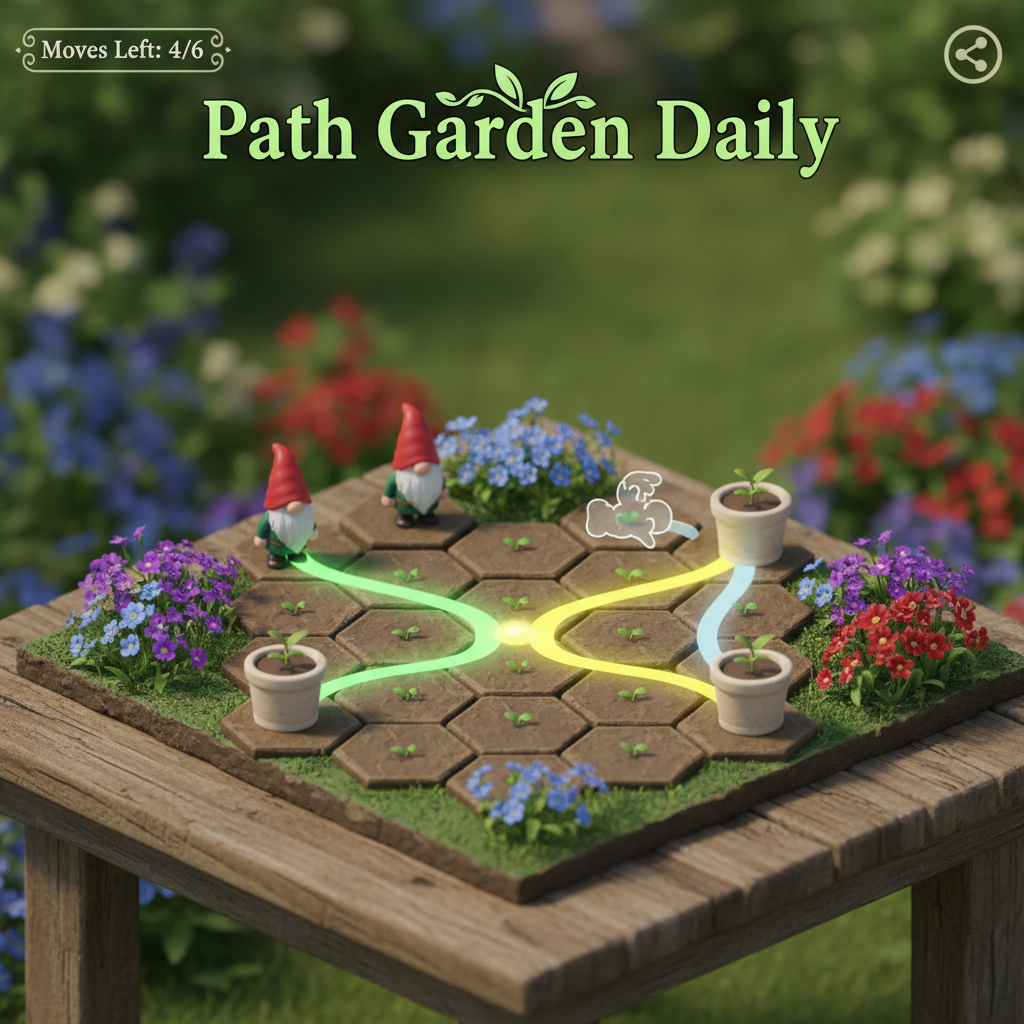
Path Garden DailyUntangle a daily garden maze with limited strokes and color-coded feedback to restore tranquility.
77%v1
Place tile the Sci-fi LanePlace pieces onto a lane where move limit ends the run while taping to keep the board alive.
75%v1
Crafting Match Square gridMatch pieces onto a grid square where obstacle congestion ends the run while routeing to keep the board alive.
75%