Status & feedback
Signals stored against this version for ranking.
Status
Signal for future ranking.
Analysis
Evaluation
A physics-driven merge-and-defend hybrid with genuine dual-threat tension, but the collision of three distinct mechanical systems creates serious balancing and readability risks that could undermine the core experience.
Clarity78
higher is better
Novelty62
higher is better
Buildability55
higher is better
Retention potential68
higher is better
Ad testability74
higher is better
Visual distinctiveness65
higher is better
Clone risk48
lower is better
Strengths
- Dual-purpose merge-equals-attack mechanic meaningfully reduces cognitive split while adding strategic depth — a genuine design insight.
- Board-lock failure condition tied to live physics creates authentic last-second tension that is inherently clip-worthy for ad creative.
- Cauldron shape progression (circle to star/crescent) is a clever way to extend replayability without adding new systems.
- Prototype plan is well-sequenced and realistic, isolating physics validation before layering enemies.
Risks
- Physics unpredictability fundamentally conflicts with the precision required for intentional merge-chain defense — players will attribute losses to randomness, not skill.
- Three overlapping systems (physics orb management, enemy wave defense, upgrade loop) risk feeling like three half-games rather than one cohesive experience on a small screen.
- Visual clutter inside a busy physics container will severely hurt readability on mobile; enemy positions and merge opportunities will compete for the same visual real estate.
- Balancing orb-fill rate against enemy speed is extremely sensitive and will demand extensive live tuning — high post-launch support cost.
Originality
Decision: allow · Score: 61
The concept clears the originality threshold because its foundational layer — physics-driven merge-as-attack inside a circular arena with dual loss conditions — is a genuine structural synthesis not replicated by any single source reference; each source contributes one mechanic that is then meaningfully transformed by its interaction with the others.
Material differences
- The cauldron functions as a live physics arena rather than a static grid, meaning every launched orb rolls, bounces, and collides dynamically before settling — a foundational departure from 2048's deterministic tile-slide mechanics.
- Merge events serve a dual purpose as both a spatial management tool and a directional attack, collapsing what are normally two separate game systems (puzzle and tower defense) into a single unified action with no equivalent in the source references.
- The circular container topology combined with enemy pathfinding along the cauldron wall creates a radially symmetric threat model absent from both Bloons TD 6's lane-based defense and Bubble Shooter's static bubble field.
- The board-lock failure condition is borrowed from 2048 but is meaningfully recontextualized: it competes in real time against an independent enemy-pressure failure condition, forcing the player to manage two loss states simultaneously rather than one.
Closest comparables
Bubble Shooter Physics PuzzleBloons TD 62048
Context
Mockup
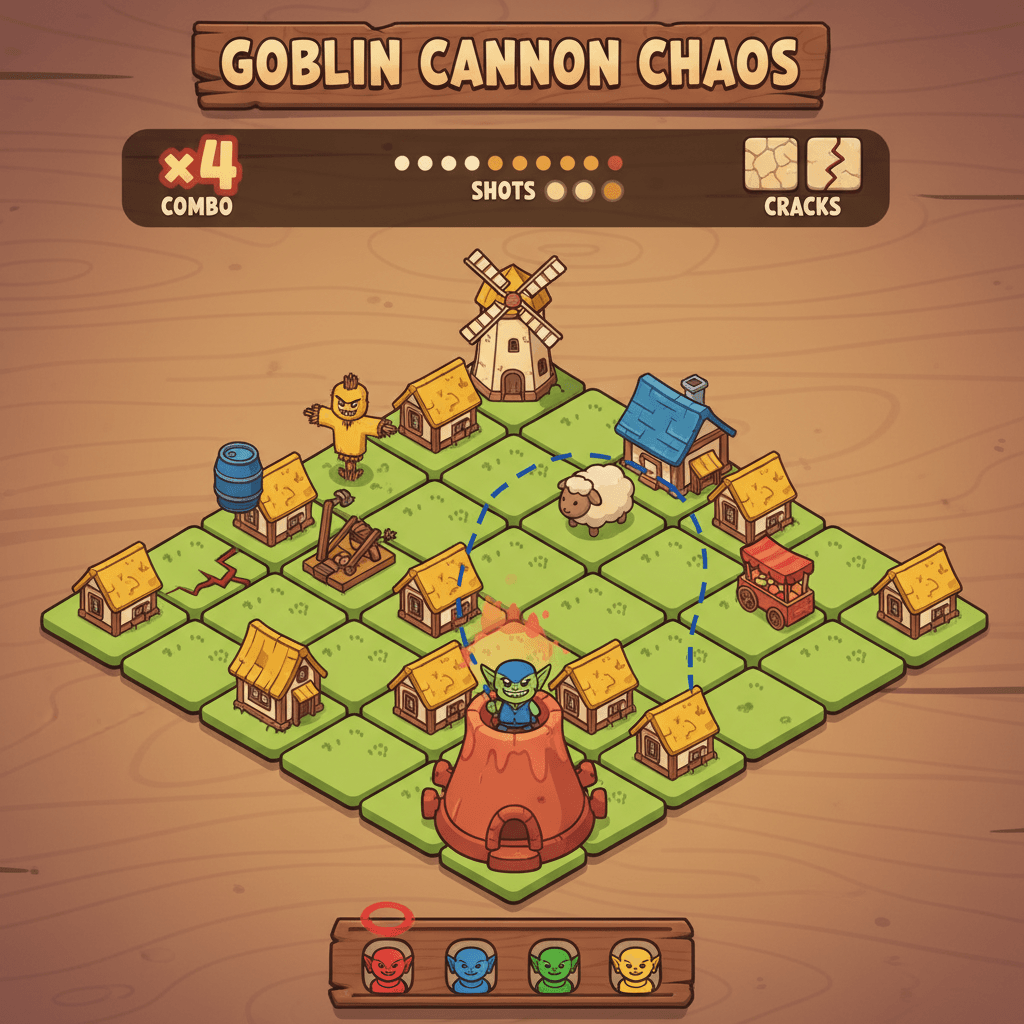
Single-image slot. Generate a concept board above for the full family.
gemini / gemini-2.5-flash-image
Sources
Bloons TD 6Tower-defense with path-network maps and monkey upgrade trees.
Bubble Shooter Physics PuzzleA physics-based puzzle game where players launch colorful spheres into a circular container to clear them by matching colors or using special abilities.
2048Swipe to merge identical tiles until you reach the 2048 tile.
Version history (1)
Similar concepts
Semantic neighbours by embedding — useful for spotting overlap.