Lifecycle
Status
Feedback
Signals stored against this version. Used later for ranking and learning.
Signal for future ranking.
Evaluation
A mechanically ambitious fusion of Subway Surfers and Traffic Escape that earns points for its dual-input tension but risks collapsing under the ergonomic and cognitive strain of sharing one screen and one finger across two simultaneous control schemes.
Clarity72
higher is better
Novelty61
higher is better
Buildability54
higher is better
Retention potential65
higher is better
Ad testability78
higher is better
Visual distinctiveness58
higher is better
Clone risk62
lower is better
Strengths
- Dual-input mechanic (swipe-to-dodge + draw-to-route) creates a genuinely novel cognitive split that is legible in a 3-second ad clip.
- Gridlock as a visually dramatic, escalating failure state produces strong near-miss moments with high shareability.
- Chest-reward cadence at district boundaries provides clear short-session satisfaction loops alongside the endless runner hook.
- City theme offers broad cosmetic surface area for monetization and is universally relatable across demographics.
Risks
- Simultaneous swipe and draw on a single small touchscreen is a serious ergonomic liability — thumb conflicts will feel unfair at high scroll speeds, not challenging.
- Casual runner audience expects single-mechanic simplicity; the dual-task cognitive load may produce frustration and early churn before the hook lands.
- Visual differentiation between the avatar's lane, NPC routes, and drawn paths on a scrolling grid will demand significant polish to avoid readability chaos.
- Heavy mechanical debt to two well-known titles (Subway Surfers, Traffic Escape) keeps clone risk elevated despite the fusion angle.
Originality
Decision: flag · Score: 28
The dual-input fusion is a legitimate foundational differentiator that clears the minimum bar, but the concept's two primary mechanics — lane-swipe running and draw-a-path traffic routing — are each lifted wholesale from their respective sources with high foundational match scores (0.85 and 0.75), so the concept should be flagged for design review to ensure the dual-input integration is sufficiently developed and not reducible to a direct overlay of the two source games.
Material differences
- The simultaneous dual-input mechanic — swipe for self-navigation and tap-drag for NPC traffic routing — on a single shared screen is not present in either source reference individually, creating a genuine cognitive-load tension that neither Subway Surfers nor Traffic Escape delivers alone.
- The player occupies a dual role as both runner-avatar and traffic controller at the same time, meaning every gesture carries compounded risk; this role-fusion is a substantive structural differentiator from the single-role mechanics of both sources.
- The congestion failure model is borrowed from Traffic Escape but is recontextualized within an endless-scrolling environment where scroll speed compounds pressure, rather than a static puzzle grid, meaningfully changing the pacing and skill expression.
- The district-boundary chest gate ties token collection (a runner mechanic) to a traffic-management survival condition, creating an emergent cross-mechanic dependency absent from either source.
Closest comparables
Subway SurfersTraffic Escape
Sources
No source anchors (random mode).
Version history (1)
Similar concepts
Semantic neighbours by embedding — useful for spotting overlap.
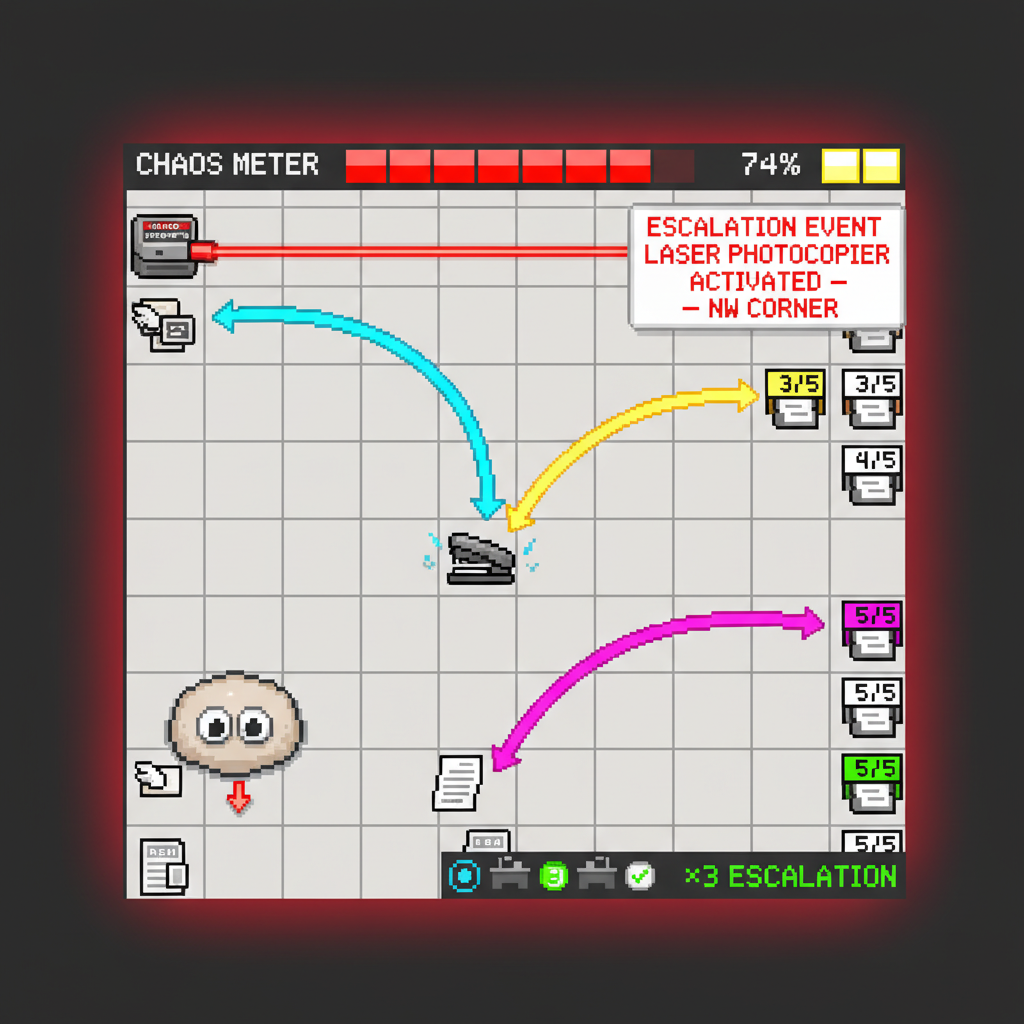
Inbox Zero ApocalypseYour office is imploding — draw frantic paths to stack paperwork before the printer gains sentience.
75%v1
Intersection InterceptorsRoute specialized city fleets through a grid-locked metropolis to intercept and neutralize incoming chaos waves.
75%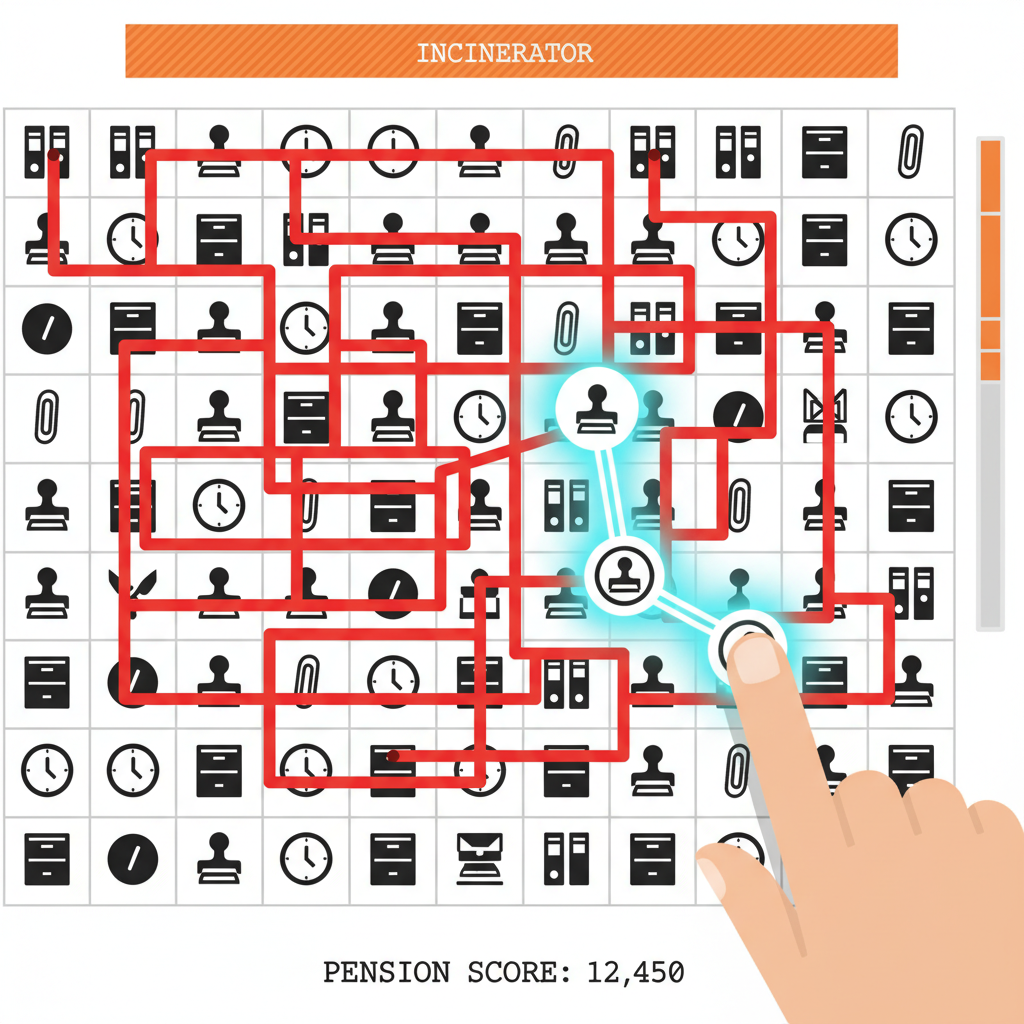
BUREAUCRACY BLITZ: RED TAPE RIOTConnect document nodes in a Bauhaus-inspired office maze where every filing success spawns permanent, path-blocking Carbon Trails.