Concept brief
You are a deep-space scavenger loading salvage blocks into a glowing neon cargo hold displayed as a CRT vector wireframe. The obvious design would be: stack blocks efficiently to fill the container and earn credits. The inversion: the container IS your score multiplier, and every combo chain you fire DEGRADES the container's walls — so playing well destroys the very thing you're trying to protect.
Core loop
1
→Incoming salvage blocks (chunky 8-colour geometric shapes) fall and you position them inside your cargo container using tap-to-rotate and swipe-to-place.
2
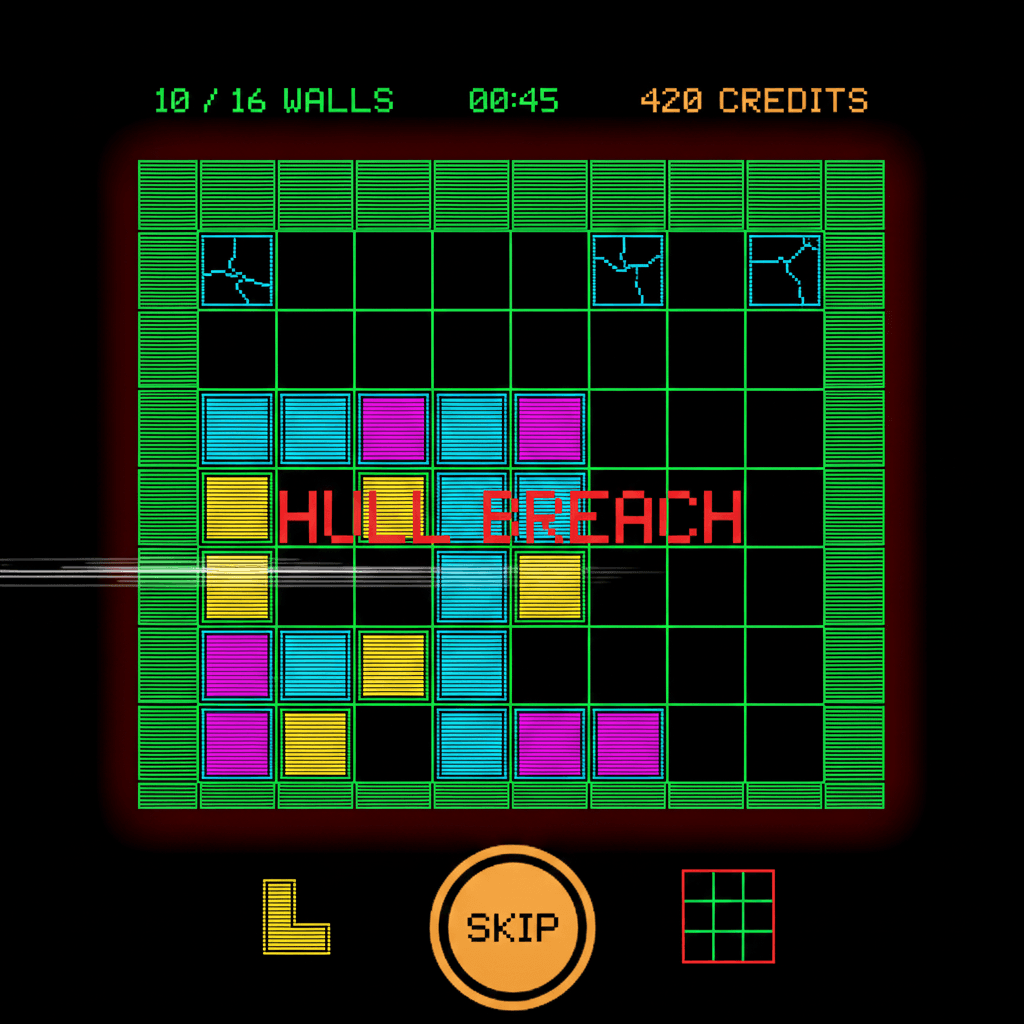
→Whenever three or more same-type blocks touch, a combo chain detonates — awarding credits BUT physically eroding one wall segment of the container (phosphor-green pixels flake off in a CRT-burn animation). A 3-block chain removes 1 of the container's 16 wall segments; a 5+ chain removes 2 simultaneously and triggers a screen-edge red-flash lasting 0.4 seconds.
3
→Credits from combos fund the meta-unlock economy: you buy hull patches (50 credits each, restores 1 wall segment), new container shapes, and passive income nodes between runs in a retro upgrade terminal screen.
4
A run ends when the container's walls degrade to zero — meaning a player who chains every combo will collapse their hold in roughly 8 combos from a full 16-segment container, while a player who skips every combo survives indefinitely but earns zero credits.
Gameplay
Rules
Every combo chain of 3+ removes one wall segment from the container's 16-segment total; chains of 5+ remove two segments simultaneously.Blocks that overflow a broken wall gap are lost forever — each lost block subtracts 10 credits from the run-end payout.You can manually SKIP a combo (tap the flashing yellow chain icon within 1.5 seconds of detection) to preserve the wall segment, but receive zero credits for that chain. The skip action plays a distinct 'suppressed detonation' sound — a muffled thud — to confirm the wall was saved.Hull patches purchased in the meta-upgrade shop restore wall segments at 50 credits each, capped at 3 patches purchasable per run-end screen, so a full 16-segment restore costs 800 credits minimum across multiple runs.Container shape changes each meta tier — the Tier 1 Standard Hold has 16 wall segments and a 6×10 grid; the Tier 2 Wide Hauler has 24 wall segments and an 8×10 grid, allowing larger stacks but exposing 50% more wall surface to combo damage.
Deciding, in under 1.5 seconds, whether to detonate a detected combo or tap Skip. A 3-chain on turn 4 of a fresh run costs 1 of 16 wall segments and pays 30 credits — a recoverable trade. The same decision on turn 20 with 3 wall segments left costs 6% of remaining run life per segment and may trigger a gap that loses the next 4 placed blocks. Skilled play means building stacks that approach-but-never-complete combo patterns, requiring players to read 2–3 block-falls ahead and deliberately misalign same-type blocks — the opposite motor habit from every match-3 game they have played before.
Why it might work
- ↑The Skip decision has a hard 1.5-second window and a visible cost on both branches — players can observe within 3 runs that skipping a 5-chain on a 4-segment container saved the run, producing a concrete before/after comparison that teaches the inversion without a tutorial.
- ↑Wall degradation is rendered as 32×32 pixel tiles crumbling with a phosphor burn-out shader and a CRT scan-line tear — the visual of a half-destroyed glowing container with blocks spilling through the gap is a single screenshot that communicates the game's entire premise, making it usable as a static ad without video.
- ↑The meta-economy has a closed loop a new player can complete in 3 sessions: earn 50 credits from combos, buy one hull patch, survive one extra combo next run, earn 80 credits, buy a second patch — each session produces a measurable run-length increase (approximately +2 wall segments per patch purchased), giving players a number to chase between sessions.
- ↑The 'HULL BREACH' 50%-speed replay of the killing combo gives players a specific frame to screenshot and share with the caption 'this is the combo that ended me' — the shareable moment is a named, replayable 3-second clip, not a vague emotional state.
Why it might fail
- ↓Players arriving from Candy Crush or Tetris will attempt to complete every combo for the first 5–10 runs before the wall-damage pattern registers; if the onboarding does not show a side-by-side credit-vs-segments counter from run 1, the inversion reads as a bug rather than a rule.
- ↓The Skip action's muffled-thud sound and zero-credit outcome may cause players to interpret it as a failed tap rather than a deliberate choice — without a '+0 credits / WALL SAVED +1' floating text confirmation, the restraint mechanic is invisible and will be abandoned within 2 sessions.
Progression
- Unlock reinforced container variants with explicit wall economies: Titanium Mesh Hold has 20 segments but each segment requires a 5+ chain (not a 3+ chain) to break; Force-Field Frame has 12 segments but regenerates 1 segment every 60 seconds of real play-time, rewarding slow deliberate sessions over fast aggressive ones.
- Meta-research tree with two named branches: 'Dampened Detonators' (3 tiers at 200/400/800 credits) reduces wall damage per 3-chain from 1 segment to 0.75/0.5/0.25 segments, accumulating fractional damage tracked visibly as a hairline crack on the tile; 'Void Insurance' (flat 500 credits) pays 15 credits per wall segment lost instead of penalising — converting wall destruction from a loss into a secondary income stream.
- Prestige layer: intentionally collapse your container in 5 combos or fewer from a full 16-segment start to unlock 'Demolition Run' mode — a 90-second timed mode where wall damage is disabled, all combos pay triple credits, and the score posts to a separate leaderboard tracked by total credits in a single Demolition Run.
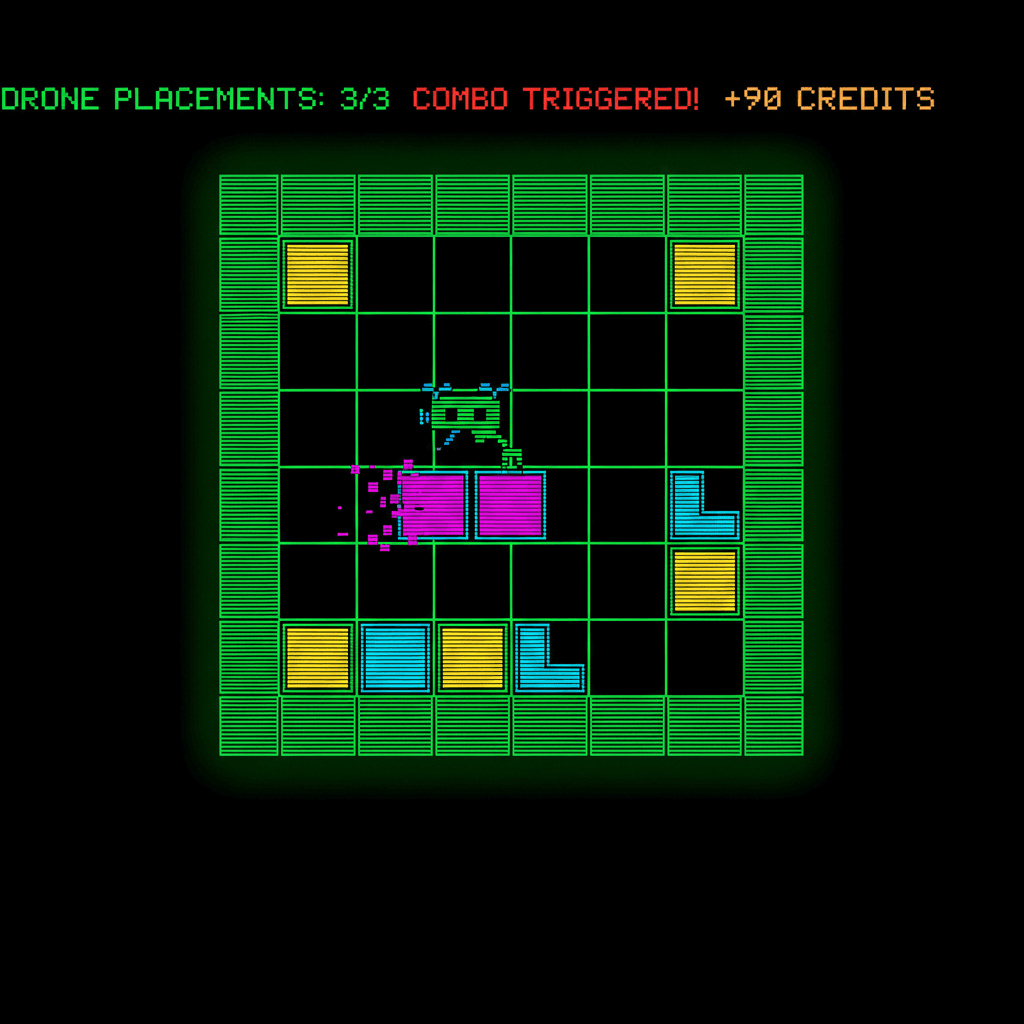
- Passive income node: the 'Salvage Drone' auto-places one block every 30 seconds while the app is backgrounded, but the drone's placement algorithm always completes the nearest 3-match — so every 3 drone placements fires one combo and removes one wall segment. Players who leave the game idle for 90 seconds return to find 3 combos triggered and 3 wall segments gone, with 90 credits earned.
- Seasonal containers shaped like retro arcade cabinets (a Pac-Man cabinet silhouette, a Space Invaders cabinet silhouette) with asymmetric wall health: the cabinet's left side has 4 segments, right side has 8 segments, top has 2 segments, bottom has 6 segments — forcing players to spatially bias their stack toward the sturdier right wall to extend run length.
Prototype plan
- 1Build a 60-second grey-box prototype with a single 4-walled container (16 segments total, 4 per wall), falling blocks in 3 colours, auto-detected 3-match combos that remove one wall tile each — no credits, no upgrades — and a visible segment counter (e.g., '14/16 WALLS') in the top corner. Run 10 back-to-back playtests with one question: 'Did you ever deliberately avoid completing a combo?' If fewer than 6 of 10 players answer yes by playtest 8, the 1.5-second Skip window is too short and must be extended to 2.5 seconds.
- 2Add the credit counter (3-chain = 30 credits, 5-chain = 60 credits) and a single meta-upgrade screen with one item: hull patch costs 50 credits, restores 1 wall segment, capped at 3 purchases. Run 5 sessions of 10 minutes each and measure whether players spend credits on patches or hoard them — if zero patches are purchased, the patch price is too high or the wall-damage rate is too slow to feel threatening; halve the patch price and retest.
- 3Apply the retro-arcade visual pass (phosphor green on black, CRT scan-line shader, 32×32 pixel wall tiles with crumble animation, 'HULL BREACH' siren on final segment) and record the exact moment a wall breaks mid-combo-chain for 5 players. Play back the recording and ask each player: 'What happened there?' If all 5 can describe 'the combo broke the wall' without prompting, the audio-visual feedback is sufficient. If any player says 'I don't know' or 'it glitched,' the red-flash duration must increase from 0.4 seconds to 0.8 seconds and the crumble animation must slow from 12 frames to 20 frames.
Ad hooks
SHOW: Player lands a perfect 7-block combo chain. CUT TO: Half the container wall explodes in neon sparks. TEXT: 'You played too well.'
SHOW: Two players side by side — one aggressively chaining combos, container crumbling; one skipping chains, container intact but score low. TEXT: 'Which type are you?'
SHOW: The container collapsing in slow-motion CRT burn as credits rain down. TEXT: 'The better you play, the faster it breaks.'
SHOW: Meta upgrade screen — player hovers over 'Hull Patch' then back to 'Void Insurance.' TEXT: 'Spend credits to survive. Or spend credits to win. You can't do both.'
Why these sources
- STACK: The literal block-placement interaction — but inverted from 'fill the container perfectly' to 'survive the consequences of how you fill it.'
- COMBO CHAIN: The reward-cadence mechanic — inverted from 'chains give you resources' to 'chains consume your container's structural integrity at a rate of 1 segment per 3-chain and 2 segments per 5-chain.'
- META UNLOCK: Provides the between-session progression layer; hull patches (50 credits, 3 per run-end cap) and container variants (Titanium Mesh at Tier 2, Force-Field Frame at Tier 3) are unlocked here, giving players a numeric run-length improvement they can observe within 3 sessions.
- ECONOMY LOOP: Credits earned from combos fund the meta-shop, which sells the hull patches destroyed by those same combos — a closed loop where the optimal credit-earning move (fire every combo) directly funds the recovery item (hull patch) made necessary by that move, and the 3-patch-per-run cap prevents the loop from trivialising the damage.
- CONTAINER: The topology — the container's 16 wall segments are not a passive backdrop but the primary depletable resource, displayed with a live segment counter, a per-wall health bar, and a crumble animation on each lost tile, making structural damage as legible as a health bar in any action game.


