Status & feedback
Signals stored against this version for ranking.
Status
Signal for future ranking.
Analysis
Evaluation
A sharply inverted crafting-defense hybrid where completing recipes destroys your walls — the inversion is mechanically coherent, the ad hooks are exceptional, but the counter-intuitive core verb carries real tutorial and retention risk.
Clarity82
higher is better
Novelty88
higher is better
Buildability74
higher is better
Retention potential71
higher is better
Ad testability91
higher is better
Visual distinctiveness79
higher is better
Clone risk18
lower is better
Strengths
- The inversion is named, justified, and mechanically load-bearing — not a theme swap but a genuine output-polarity reversal that creates a distinct decision space no current mobile title occupies.
- Ad testability is elite: the 'tutorial bait' hook (follow the prompt, wall explodes, rewind) is a self-contained 15-second clip with a clean punchline and no explanation required.
- The Emergency Drag recharge creates a designed emotional arc per wave — pressure → near-cascade → relief beat — which is a retention-friendly rhythm that most one-mechanic mobile games lack.
- Prototype plan is unusually disciplined: three material types, two hardcoded recipes, one wave, explicit success criteria per step — this can reach a testable build in under two weeks.
Risks
- Counter-intuitive core verb has a narrow tutorial window: if the forced wave-1 detonation misfires or feels cheap rather than instructive, a significant portion of players will churn before internalizing the inversion.
- Late-wave board density (20+ tiles) risks visual noise overwhelming the opacity-dimming mitigation — the 60%/100% brightness split may not survive a real 375px screen at speed without extensive playtesting iteration.
- Retention cliff at day 3 is self-identified and the Cursed Tile drip is a thin counter — the run-to-run variance depends almost entirely on random tile drop order, which may feel samey to players who reach wave 8+ regularly.
- Auto-craft trigger timing is load-bearing and brittle: any frame-rate inconsistency between the adjacency check and the magenta pulse start will produce 'unfair' detonations that players attribute to the game, not themselves — this is a significant QA surface on low-end Android devices.
Originality
Decision: allow · Score: 81
The inversion of crafting-as-destruction constitutes a substantive differentiator at the foundational mechanical layer — not merely a reskin of existing grid-defense or crafting loops — and the three-consequence single-verb drag system creates a decision architecture not present in any of the closest comparables. The concept clears the threshold for at least one substantial foundational differentiator.
Material differences
- The core inversion — where completing a crafting recipe destroys your defense rather than building it — fundamentally subverts the output polarity of every grid-crafting antecedent (Minecraft, Little Alchemy, Dorfromantik), making the player's trained reflex the primary failure vector rather than a solution pathway.
- The dual-use drag verb (one input simultaneously closes invader paths, breaks recipe formations, and risks opening new ones) creates a three-consequence decision space absent in tower-defense games like Bloons or Minit, where placement and combat are mechanically separated.
- The 'hoard raw chaos as perimeter defense' win condition — where unprocessed, uncombined material IS the fortress — constitutes a structurally distinct victory logic from any comparable grid-defense or crafting title, where processed/combined outputs are always the defensive asset.
- The Emergency Drag as a single-per-wave interrupt that functions as both a recipe-breaker and a path-router, recharged by a designed audio-visual exhale beat, creates a tension-release emotional arc that is architecturally novel relative to the cooldown systems in standard tower-defense games.
Closest comparables
Minit (single-action constraint loop with inversion-based learning)Dorfromantik (tile placement on a square grid with adjacency-triggered scoring consequences)Bloons Tower Defense (wave-based grid defense with pathing manipulation)
Context
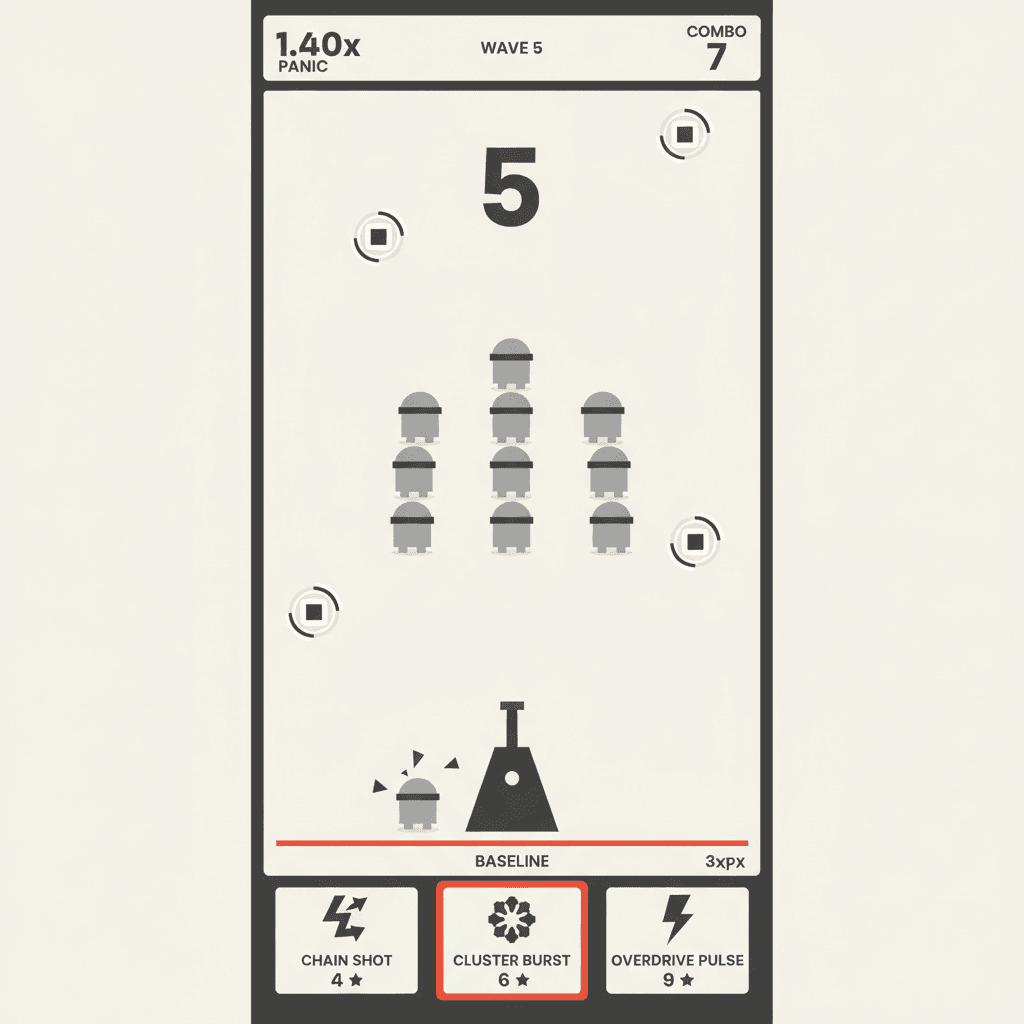
Mockup
Single-image slot. Generate a concept board above for the full family.
gemini / gemini-2.5-flash-image
Sources
No source anchors (random mode).
Version history (1)
Similar concepts
Semantic neighbours by embedding — useful for spotting overlap.